
5 Best Fan for RV Bedroom for Quiet Sleep
The Honeywell HT900 TurboForce Air Circulator Fan is the best fan for rv bedroom for most buyers because its compact design delivers focused airflow without taking much space. This small air circulator fits well on a nightstand, shelf, or other tight RV surface. Its three-speed control makes it easier to adjust airflow after sunset, when a full-size floor fan can feel excessive. The pivoting head directs air toward the bed rather than across the entire room. It is a practical pick for campers who want simple controls and steady circulation from a standard outlet.
This guide is for RV owners who need cooler, better-moving air in a compact sleeping area. Size matters first, since crowded bedside spaces leave little room for a wide base. Noise level matters next, especially for light sleepers, while power needs affect where you can use the fan. A plug-in circulator may suit a parked RV, but battery-powered models offer more freedom away from hookups. The five picks below are ranked with clear reasons and honest drawbacks for each, so you can compare comfort, placement, and daily convenience before choosing a small fan.
Quick Comparison
| # | Product | Best For | Price | |
|---|---|---|---|---|
| 1 | Honeywell HT900 TurboForce Air Circulator Fan | Small Room Airflow Boosters | ~$19 | View → |
| 2 | LEMOISTAR 8-Inch Wall-Mounted RV Fan | RV Bunk Cooling | ~$46 | View → |
| 3 | Personal Tower Cooling Fan | Personal Desk Cooling | ~$33 | View → |
| 4 | DREO Tower Fan | Quiet Bedroom Comfort | ~$65 | View → |
| 5 | DREO Standing Oscillating Fan | Whole-Room Oscillating Airflow | ~$80 | View → |
5 Top RV Bedroom Fan Picks
These fans are ranked for airflow, noise control, and space-saving design, counting down to the top pick.
5. DREO Standing Oscillating Fan
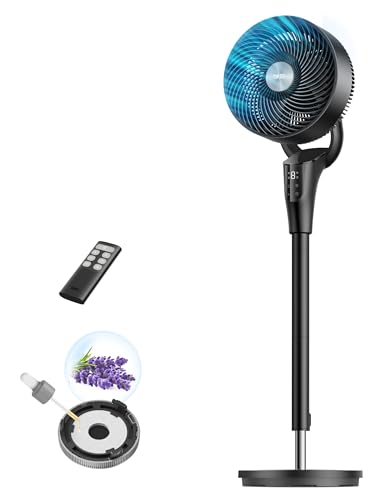
Best for: Hot sleepers in medium bedrooms
The DREO is a height-adjustable pedestal fan built for bedrooms, living rooms, and kitchens. Its DC motor and redesigned blades support airflow rated at up to 1,000 CFM, with circulation reaching as far as 90 feet. DREO says it can move room air in under two minutes. Eight speed settings give you more control than basic three-speed fans, while an 8-hour timer helps limit overnight runtime.
Its 90-degree horizontal oscillation and 105-degree head pivot send air across a wider area. The height adjusts from 38 to 42 inches, so it can sit lower near children or pets and higher beside a bed. A remote lets you change settings from across the room, and you can mute its button sounds. The detachable front grille, rear grille, and blades make cleaning less awkward. An aroma pad adds fragrance, though scented airflow will not suit everyone. At around $80, this fan fits buyers who want broad circulation and more controls than a budget pedestal model.
Pros
- Moves air across large rooms with up to 1,000 CFM and a claimed 90-foot reach.
- Offers precise airflow direction with 90-degree oscillation and a 105-degree pivot.
- Includes eight speeds, auto mode, an 8-hour timer, and remote controls.
Cons
- The 38-to-42-inch height range provides only 4 inches of adjustment.
- It circulates air but does not lower room temperature like an air conditioner.
4. DREO Tower Fan

Best for: Bedrooms needing adjustable nighttime airflow
The DREO Tower Fan is a floor-standing fan for bedrooms, offices, and living spaces. Its upgraded brushless DC motor can produce airflow up to 28 ft/s, with a stated reach of 34 feet. At around $65, it offers more control than a basic three-speed fan, though it does not replace an air conditioner.
Eight speed settings cover gentle breezes and stronger airflow. Four modes, Normal, Natural, Sleep, and Auto, let you adjust the fan for different times of day. The fan also oscillates through 90 degrees, helping spread air across a room instead of pushing it in one direction. A remote and top touch controls provide two ways to change settings. DREO lists a quieter impeller design for work and nighttime use, but it does not provide a specific decibel rating. The rear grille and impeller are removable for cleaning. An ETL certification, fused plug, and circuit protection add useful safety features.
Pros
- Eight speeds make it easier to fine-tune airflow.
- Sleep and Auto modes suit bedrooms and changing room conditions.
- Removable rear grille and impeller simplify dust removal.
Cons
- The 90-degree oscillation may not cover wide or open rooms fully.
- It moves air but does not actively lower room temperature like an air conditioner.
3. Personal Tower Cooling Fan

Best for: Small bedrooms and dorm rooms
This compact 13-inch tower fan provides personal cooling for bedrooms, offices, desks, and dorms. Its three speed settings support light airflow or stronger cooling, with a claimed maximum of 24 feet per second. The built-in handle makes it easier to move between rooms, while the simple control panel keeps adjustments quick.
Dual oscillation settings offer either a focused 60-degree sweep or broader 110-degree room coverage. The listed noise range is 25 to 45 decibels, so the lowest setting should suit sleep or desk work better than many louder floor fans. A 12-hour timer can shut the fan off overnight, and the programmable auto-on feature can start it on a schedule. At around $33, it offers useful controls in a small package, but the compact size also limits how much air it can move across a large room.
Pros
- Three speeds and 24-foot-per-second airflow give you more control over cooling.
- Choose 60-degree or 110-degree oscillation for personal airflow or wider circulation.
- A 12-hour timer, low-noise setting, and portable handle suit bedrooms and desks.
Cons
- The 13-inch body may not cool large rooms as effectively as a full-size tower fan.
- The listed noise range reaches 45 decibels, so higher speeds may be noticeable during sleep.
2. LEMOISTAR 8-Inch Wall-Mounted RV Fan

Best for: Small rooms, RVs, and workspaces
The LEMOISTAR 8-inch wall-mounted fan fits corners where a floor fan would waste space. It suits RV bedrooms, home offices, garages, workshops, and greenhouses. Its 70-inch cord gives you some placement flexibility, while the adjustable head tilts vertically through 120 degrees. The fan also swings 90 degrees from side to side, spreading air across a wider section of the room.
Four speed settings cover low, medium, high, and super airflow. The listed air velocity reaches 25 feet per second, which is strong for such a compact unit. Noise is rated between 25 and 40 decibels, though actual sound can vary by speed and mounting surface. A remote controls the speed and timer, and its battery is included. Timer choices run for 30 minutes, 1.5 hours, 4 hours, or 8 hours. The control panel provides a backup. At around $46, it costs more than basic tabletop fans, but its wall-mounted design saves usable floor space.
Pros
- 90-degree oscillation and 120-degree tilt direct air across different angles.
- Four speeds and four timer choices support sleep, work, and cooling routines.
- Compact 8-inch size and wall mounting keep floors and countertops clear.
Cons
- The small fan head may not cool large rooms evenly without close placement.
- Wall mounting limits portability compared with a tabletop or stand fan.
1. Honeywell HT900 TurboForce Air Circulator Fan

Best for: Personal desk cooling in small rooms
The Honeywell HT900 is a compact black air circulator for a desk, table, floor, or wall mount. Its three-speed control lets you choose a lighter breeze or stronger airflow. The head pivots through 90 degrees, so you can aim air upward, downward, or toward a nearby seating area. Honeywell rates the fan as 25% quieter than comparable models, which may suit an office, bedroom, or study space.
Its turbo-style blade design moves air up to 25 feet away, according to the manufacturer. That reach can help improve airflow in small to medium-sized rooms, though this remains a personal fan rather than a full-room cooling system. At around $19, it costs less than many larger circulators. It can also help reduce air conditioner use when you only need localized airflow. The compact design saves desk space, but the 90-degree adjustment requires manual positioning.
Pros
- Three speeds provide more control than a single-speed personal fan.
- The 90-degree pivoting head directs airflow toward a desk, bed, or chair.
- Compact size supports tabletop, floor, and wall-mounted placement.
Cons
- The head pivots but does not oscillate from side to side, so coverage stays limited.
- Its small frame may not move enough air for large rooms or whole-room cooling.
Buying Guide
The most important factor is nighttime noise. Choose a fan rated below 40 dB on low, because a loud motor can disturb sleep even when the RV feels cool.
- Noise rating: Aim for less than 40 dB on the lowest setting. Models above 50 dB may sound intrusive in a small sleeping area.
- Size and mounting: Measure the bedside shelf, wall, or bunk edge first. A 6- to 10-inch clip or tabletop fan usually fits better than a 12-inch floor model.
- Airflow control: Look for at least three speeds and adjustable tilt. A fan with oscillation or a pivoting head can move air across a 6- to 10-foot sleeping space.
- Power draw: For boondocking, choose a 12-volt or USB fan using about 0.5 to 1.5 amps. USB models can run from a 10,000 mAh power bank during the night.
- Timer and safety: A one-, two-, or four-hour timer helps limit battery drain. Select a fan with a covered grille, stable base, and controls that remain easy to reach in darkness.
If you cannot have everything, prioritize low noise first, then choose the largest safe size that fits your RV bedroom.
Frequently Asked Questions
How do I choose a quiet fan for an RV bedroom?
Choose a quiet RV bedroom fan with a low-speed setting, compact housing, and a noise rating below about 40 decibels when available. A 12-volt model can connect to the coach electrical system, while a USB fan works from a power bank. Check its footprint before placing it on a narrow nightstand.
What size fan works best in a camper bedroom?
A 6- to 10-inch fan usually fits an RV bedroom without taking over the sleeping area. Smaller units suit nightstands and shelves, while larger models move more air but need extra clearance. Measure the available space first, including the cord path, and choose a fan with adjustable tilt for better airflow.
Can I use a battery-powered fan overnight in an RV?
Yes, you can use a battery-powered fan overnight in an RV if its battery capacity covers the full sleep period and the unit has stable placement. Many portable fans run for roughly 6 to 12 hours, depending on speed. Select a model with a guarded grille and charge it before bedtime.
Are wall-mounted fans better for RV bedrooms?
Wall-mounted fans can be better for RV bedrooms because they free up limited shelf and floor space. An 8- to 10-inch unit often provides useful airflow without crowding the bed, but installation requires a solid mounting point. Check the fan’s swing range so it does not hit cabinets, windows, or slide-outs.
Conclusion
Honeywell HT900 TurboForce Air Circulator Fan is the top pick for RV owners who want strong airflow from a compact, easy-to-place fan in a bedroom or bunk area. If your priority is quieter overnight operation, choose a smaller, lower-speed model instead, since reduced airflow can be a fair trade for less bedroom noise. Before buying, double-check the fan’s dimensions against your available shelf or floor space, confirm its power and outlet compatibility, decide how many units you need, and compare the current price with similar options. An RV bedroom has limited room, so placement matters as much as motor power. Keep the fan clear of bedding, curtains, and walkways, and use the lowest setting that keeps air moving comfortably.
