5 Best Grow Light for 3×3 Tent on a Budget
For most buyers, the Mars Hydro FC-E3000 LED Grow Light is the best grow light for 3×3 tent, mainly because its 300-watt board provides strong, even coverage across the full growing area. Its adjustable output also gives growers more control as plants move from seedlings to flowering.
This guide is for indoor gardeners comparing lights for a complete 3-by-3-foot setup. The most important factors are actual power draw and usable coverage, since both affect plant growth, heat, and electricity costs. Dimming controls matter too, especially when young plants need less intensity. The five picks below are ranked by their strengths, with clear reasons and honest drawbacks for each. That makes it easier to match a light with your plants, budget, and ventilation setup.
Quick Comparison
| # | Product | Best For | Price | |
|---|---|---|---|---|
| 1 | Mars Hydro FC-E3000 LED Grow Light | Budget-Minded 3×3 Growers | ~$170 | View → |
| 2 | Spider Farmer G3000 LED Grow Light | High-Efficiency Indoor Gardeners | ~$180 | View → |
| 3 | VIVOSUN AeroLight LED Grow Light | Growers Needing Built-In Airflow | ~$280 | View → |
| 4 | VIVOSUN GIY Smart Grow Tent System | First-Time Smart Tent Users | ~$435 | View → |
| 5 | Spider Farmer SE3000 LED Grow Light | Even-Canopy Light Coverage Seekers | ~$200 | View → |
5 Top Grow Lights for 3×3 Tents
This ranked list counts down from the fifth option to the top pick, and each placement considers coverage, control, and value.
5. Spider Farmer SE3000 LED Grow Light

Best for: 3×3-foot indoor grow tents
The Spider Farmer SE3000 is a 300-watt LED grow light designed for indoor plants from seedlings through flowering. Its bar-style frame uses Bridgelux diodes and produces 826 µmol/s, with light spread across a 3×3-foot growing area. The layout helps reach plants near the edges more evenly than a compact, single-panel fixture. Around $200, it costs more than basic plug-in grow lights, but it includes more control options.
The tuned spectrum combines blue light around 437nm, deep red light from 660–665nm, and white LEDs in the 2800–3000K and 4800–5000K ranges. A digital dimmer lets growers adjust brightness with a dial, while the Spider Farmer app adds schedules, sunrise and sunset simulations, and remote brightness changes. That flexibility suits multi-stage growing. The light also includes five years of after-sales coverage, with repair centers listed in the US, Canada, UK, and Germany.
Pros
- 826 µmol/s of output supports strong coverage across a 3×3-foot tent.
- App controls offer schedules, sunrise and sunset simulations, and remote dimming.
- Digital dimming allows separate brightness levels for seedlings, vegetative growth, and flowering.
Cons
- Its 300-watt draw may raise electricity costs compared with smaller lights.
- Coverage is limited to about 3×3 feet, so larger grow spaces need another fixture.
4. VIVOSUN GIY Smart Grow Tent System
Best for: App-controlled growing in compact spaces
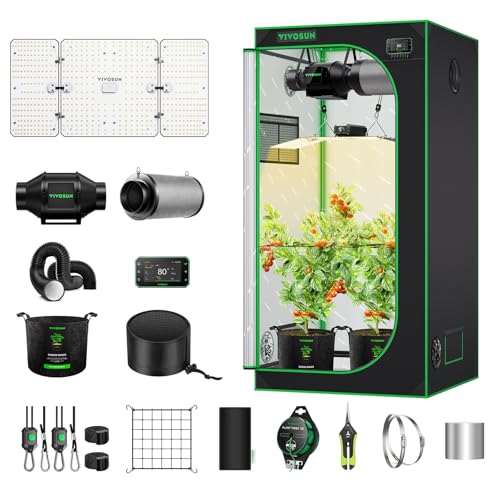
The VIVOSUN GIY Smart Grow Tent System bundles a 36 × 36 × 72-inch tent with a 200W full-spectrum LED, 4-inch inline fan, carbon filter, ducting, and GrowHub E42A+ controller. It costs around $435, though pricing can change. The package also includes five 5-gallon grow bags, a 3 × 3-foot trellis net, two vent covers, pruning shears, rope hangers, and aluminum duct tape.
The controller connects the light and fan through one app. Temperature and humidity sensors track conditions inside and outside the tent, while schedules can automate daily operation. The light uses 3000K, 5000K, 660nm, and 730nm diodes for different growth stages. The AeroZesh fan moves up to 195 CFM, with PWM control for adjustable airflow and lower power use. This is a well-rounded starter setup, but its compact footprint favors a small indoor garden rather than a large collection of plants.
Pros
- Includes the main equipment, plus five grow bags and useful pruning supplies.
- App control combines light scheduling, fan adjustments, and climate monitoring.
- The 200W light and adjustable 195 CFM fan suit a 3 × 3-foot growing area.
Cons
- The 72-inch height can restrict tall plants, especially after adding the light and hangers.
- Smart controls depend on WiFi and app setup, which adds complexity beyond a basic timer.
3. VIVOSUN AeroLight LED Grow Light

Best for: Grow tents with changing plant stages
The VIVOSUN AeroLight 350W is an indoor LED grow light built around sealed light bars and a central fan. It uses adjustable spectrum settings for root development, leafy growth, and flowering. The fan moves air across the canopy, which can reduce stagnant pockets and help balance humidity and carbon dioxide movement inside a tent. Its aluminum finned heatsink manages heat, while the IP65 rating protects the bars from dust, moisture, and routine cleaning exposure.
This model claims 20% higher output and up to 0.91 uniformity across the canopy. Micro-lens optics can also raise PPFD by up to 20% and send more light into lower foliage. Power stays constant as the spectrum changes, so intensity should remain more stable between growth stages. The light supports app-based scheduling and remote adjustments through the VIVOSUN GrowHub, sold separately. Rated life reaches up to 50,000 hours under the Q90 standard. At around $280, it targets growers who want one fixture for a full cycle.
Pros
- Central fan improves air movement through dense plant canopies.
- IP65-sealed bars resist dust, moisture, and cleaning exposure.
- Adjustable spectrum and constant power cover multiple growth stages.
Cons
- The GrowHub controller costs extra for app control and automation.
- A 350W fixture uses more electricity than lower-powered lights.
2. Spider Farmer G3000 LED Grow Light

Best for: 3×3-foot indoor grow tents
The Spider Farmer G3000 is a 300-watt LED grow light designed for indoor plants from seed through harvest. Its extended light-bar layout spreads coverage across a 3×3-foot growing area, including the edges. Inside, 896 diodes produce 824 μmol/s with a stated efficiency of 2.75 μmol/J. The full-spectrum output combines 3200–4200K, 4800–5000K, and 660–665nm wavelengths.
Brightness adjusts with a dimmer and built-in digital display, so you can reduce intensity for young plants and increase it as the canopy develops. The light also supports daisy-chaining, with one master unit able to control up to 50 lights. App control adds custom schedules, remote brightness changes, and sunrise or sunset simulations. That can help maintain a routine during travel. Around $180, it costs more than basic panel lights, but the five-year coverage and U.S.-based service center add useful support for a long-term setup.
Pros
- 896 diodes provide broad, even light across a 3×3-foot area.
- App controls schedules, brightness, and sunrise or sunset simulations remotely.
- Dimming, a digital display, and five-year coverage support easier long-term use.
Cons
- Its 3×3-foot coverage may not suit larger tents or wide plant rows.
- App features require setup and a compatible phone, while the light still draws 300 watts at full output.
1. Mars Hydro FC-E3000 LED Grow Light

Best for: Budget-minded 3×3 tent growers
The Mars Hydro FC-E3000 is a 300-watt, full-spectrum LED grow light designed for both vegetative growth and flowering. Its bar-style layout covers up to a 3×3-foot area, with a more concentrated 2×2-foot core. Bridgelux diodes provide a listed efficiency of 2.8 µmol/J and a listed PPF of 840 µmol/s. At around $170, it targets growers who want broad coverage without paying for a higher-end fixture.
The upgraded version adds OSRAM red-spectrum diodes to support flowering, with the company listing 4.48 µmol/J for that red output. The removable bar sections can help with heat management, but the light requires assembly before use. Remote scheduling and dimming are available through the Mars Hydro App when paired with the iConnectu, Controller, or iHub-Pro accessories. Those control devices cost extra, so the basic package does not provide full smart-light functionality.
Pros
- Covers a full 3×3-foot grow area, with stronger central coverage across 2×2 feet.
- The 300-watt Bridgelux LED setup lists 2.8 µmol/J efficiency for lower power use.
- OSRAM red diodes add targeted flowering output without requiring a separate bloom fixture.
Cons
- Assembly is required before the fixture can be used, which adds setup time.
- App control, remote scheduling, and advanced dimming require a separately purchased accessory.
Buying Guide
For a 3-by-3-foot grow tent, coverage and usable light output matter most. Choose a fixture that spreads light across all 9 square feet, rather than producing a bright center and dim corners.
- Actual wattage: Look for an LED panel drawing about 240 to 300 watts from the wall for flowering plants. Marketing wattage often describes theoretical diode power, not real consumption.
- Light intensity: Target roughly 300 to 600 PPFD for leafy growth and 600 to 900 PPFD during flowering. A PAR meter or reliable manufacturer map can confirm coverage at canopy height.
- Fixture size: A panel around 20 to 24 inches wide usually fits a 3-by-3 tent well. Confirm the hanging points and leave clearance from the tent walls.
- Heat and controls: Choose dimming from 25% to 100%, plus a timer or timer compatibility. Budget room for an exhaust fan, since a 250-watt fixture can add noticeable heat.
- Build and cost: Expect to pay about $120 to $300 for a suitable LED board. Check for a metal heat sink, a replaceable driver, and at least a three-year warranty.
If you must compromise, prioritize even PPFD coverage over extra features or decorative design.
Frequently Asked Questions
How many watts does a 3×3 grow tent need?
A 3×3 tent usually needs a full-spectrum LED grow light with about 300 to 500 watts of actual power, depending on the crop and growth stage. For flowering plants, a dimmable 400-watt model gives useful headroom, while seedlings need far less output and should sit farther from the diodes.
What light spectrum is best for plants in a 3×3 tent?
Full-spectrum white LED light is the most versatile choice for a 3×3 tent because it supports seedlings, leafy growth, and flowering without a bulb change. Look for a fixture around 3,000 to 5,000 Kelvin, or a model that combines warm and cool white diodes.
Can one LED grow light cover a 3×3 tent?
Yes, one properly sized LED can cover a 3×3 tent if its footprint matches the space and its actual power reaches roughly 300 to 500 watts. Choose a fixture with a dimmer, then reduce output for seedlings and raise it as plants mature.
Are bar-style grow lights better for a 3×3 tent?
Bar-style grow lights can provide more even coverage across a 3×3 tent, but they are not automatically better than a well-designed board fixture. Compare the advertised coverage, actual wattage, dimming control, warranty, and hanging height before choosing; many suitable fixtures use four or six light bars.
Conclusion
Mars Hydro FC-E3000 LED Grow Light is the top pick for growers who want one fixture for a 3-by-3-foot tent and a practical mix of coverage, control, and price. If your priority is lower upfront cost, simpler controls, or a different hanging layout, choose the reviewed alternative that matches that need instead. Before buying, double-check the light’s dimensions, tent compatibility, required quantity, and current price, since listings and bundles can change. Also confirm the return policy and warranty terms, especially when ordering online. A suitable fixture should fit the tent without crowding the frame, provide enough adjustment for each growth stage, and match your outlet and timer setup. That final check can prevent an expensive mismatch.