
6 Best Camping Knife Sharpener for Backpackers
The Work Sharp Guided Field Sharpener is my top pick for most buyers, and the best camping knife sharpener because one compact tool covers several sharpening steps. Its built-in angle guides help keep your edge consistent, while diamond plates, ceramic rods, and a leather strop handle dull pocket knives, camp blades, and larger outdoor tools. It is a practical choice for a pack, glove box, or kitchen drawer.
This guide is for campers, hikers, hunters, and anyone who maintains knives away from home. For this type of sharpener, size and construction matter most. It should pack easily, and its abrasive surfaces should keep working without feeling fragile. Clear angle guides also help when you need a quick outdoor touch-up. The 6 picks below are ranked with reasons and honest drawbacks for each, so you can match the sharpener to your gear and routine.
Quick Comparison
| # | Product | Best For | Price | |
|---|---|---|---|---|
| 1 | Work Sharp Guided Field Sharpener | Guided outdoor knife maintenance | ~$40 | View → |
| 2 | SHARPAL 101N Pocket Knife Sharpener | Pocket-sized emergency sharpening | ~$13 | View → |
| 3 | Kershaw Ultra-Tek Sharpener | Serrated knife touch-ups | ~$24 | View → |
| 4 | Smith's CCKS 2-Step Knife Sharpener | Simple kitchen knife sharpening | ~$7 | View → |
| 5 | Work Sharp Guided Field Sharpener Elite | Precise field edge work | ~$65 | View → |
| 6 | Gerber Edgefield Knife Sharpener | Budget-friendly everyday sharpening | ~$13 | View → |
6 Camping Knife Sharpeners Worth Considering
This ranked list moves from practical options to the strongest overall choice, counting down to the top pick.
6. Gerber Edgefield Knife Sharpener

Best for: Campers carrying folding knives
The Gerber Edgefield is a compact pull-through sharpener for field kits, toolboxes, and everyday carry. Its rotating core combines a diamond-coated 220 coarse-grit surface, a 600 fine-grit surface, and a ceramic rod for final honing. That gives you three stages for restoring and refining a knife edge without packing separate stones.
Its angle guide helps keep each pass consistent, while stabilized feet provide a steadier base during use. A protective closure covers the sharpening section between jobs. At 7.1 inches long, less than 1 inch wide, and under 3 ounces, it takes little room in a camping or fishing pack. Around $13, it also costs less than many larger sharpening systems. The main limit is its compact design. It suits quick maintenance and edge touch-ups better than major repairs on damaged blades or full-size kitchen knives.
Pros
- Three sharpening surfaces cover coarse grinding, fine sharpening, and ceramic honing.
- The angle guide supports more consistent passes for less experienced users.
- Its 7.1-inch length and sub-3-ounce weight fit easily in small packs.
Cons
- The narrow, portable design is not ideal for heavy blade reprofiling.
- Pull-through sharpeners offer less control than stones for users who need exact edge angles.
5. Work Sharp Guided Field Sharpener Elite

Best for: Hunters, anglers, and campers
The Work Sharp Guided Field Sharpener Elite is a manual, all-in-one tool for maintaining knives away from home. It includes five abrasive surfaces, diamond plates, ceramic honing surfaces, and a leather strop. Built-in guides support 20- or 25-degree edge angles, giving users a repeatable setup for common outdoor knives. The parts fit inside a protective travel case, with no assembly or extra tools required.
Several details make this sharpener more useful than a basic pocket stone. The ceramic rod rotates to provide coarse and fine honing surfaces, plus a grooved section for fish hooks. Removing the diamond plates exposes a broadhead wrench, which can help hunters make quick adjustments in the field. The case keeps the sharpener and accessories together for fishing trips, hikes, or camp kits. Around $65, it costs more than simple pull-through sharpeners, but it offers more control and functions in one package. Work Sharp designs and calibrates the tool in Oregon, while sourcing components from the United States and other countries.
Pros
- Five abrasive surfaces cover sharpening, honing, and stropping tasks.
- Rotating ceramic rod includes coarse, fine, and fish-hook grooves.
- Removable diamond plates reveal a broadhead wrench for field use.
Cons
- The 20- and 25-degree guides do not cover every knife edge angle.
- Manual sharpening takes practice and more time than an electric sharpener.
4. Smith’s CCKS 2-Step Knife Sharpener

Best for: Anglers and hunters needing field touch-ups
Smith’s CCKS is a small, two-stage pull-through sharpener for pocket, hunting, and fillet knives. The coarse slot uses crossed tungsten carbide blades to restore a dull edge, while crossed ceramic rods refine sharper knives. Its preset angles simplify sharpening, and three to four passes through the coarse slot can refresh a noticeably worn edge.
At around $7, this tool offers practical backup value for a tackle box or hunting pack. It measures 2.33 by 2.71 inches and weighs under 2 ounces, so it takes up little room. A lanyard hole allows attachment to a keychain or backpack. The plastic body floats, which suits fishing trips, while rubber feet help keep it stable on a flat surface. It also wipes clean with a damp cloth. The fixed slots are convenient, but they give users less control than a sharpening stone or adjustable system.
Pros
- Two stages handle dull-edge repair and fine touch-ups.
- Compact 2.33-inch size and sub-2-ounce weight suit outdoor carry.
- Floating body, rubber feet, and lanyard hole fit fishing and hunting use.
Cons
- Preset angles limit control over the edge angle.
- Pull-through carbide blades can remove more material than careful stone sharpening.
3. Kershaw Ultra-Tek Sharpener

Best for: Pocket sharpening for EDC owners
The Kershaw Ultra-Tek is a 9-inch portable sharpener with a 600-grit diamond-coated oval shaft. Its fine abrasive can realign an edge and restore everyday sharpness on pocket knives, kitchen blades, and outdoor tools. The shaft stores inside the black 6061-T6 anodized aluminum handle, which protects the abrasive during transport and keeps the tool compact. Setup takes a simple reversal: unscrew the shaft, turn it around, and secure it to the opposite end of the handle.
At 1.7 ounces, this sharpener adds little weight to a kit, drawer, or camp bag. It needs no oil or water, so maintenance stays quick and clean. The oval shaft offers more contact surface than a narrow round rod, but you still need to control the sharpening angle by hand. Around $24, it costs more than basic ceramic rods, though the built-in storage and diamond surface add convenience. Its 600-grit finish suits routine touchups and moderately dull edges. Severely damaged blades may need a coarser abrasive or a guided sharpening system.
Pros
- 600-grit diamond coating works on many common knife types.
- Shaft stores inside the durable aluminum handle.
- 1.7-ounce build fits easily in travel and outdoor kits.
Cons
- No angle guide, so consistent sharpening takes practice.
- Fine 600-grit abrasive is not ideal for major chips or heavy reprofiling.
2. SHARPAL 101N Pocket Knife Sharpener
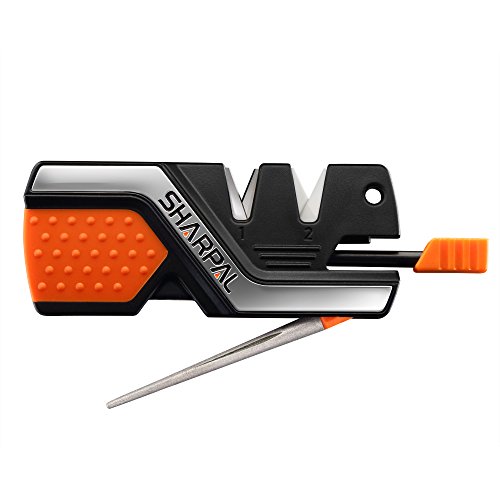
Best for: Campers carrying one compact backup
The SHARPAL 101N combines six field tools in one pocket-sized body. It has a coarse carbide V-notch for damaged or very dull blades, plus a fine ceramic slot for finishing the edge. A tapered, medium 400-grit diamond rod handles serrations and gut hooks. Its grooved diamond section targets fishhooks.
The tool also includes a ferro rod and a high-pitched emergency whistle. A lanyard hole lets you attach it to a pack, belt, or gear pouch. The preset sharpening angle makes basic sharpening simpler, though it gives you less control than a separate stone. SHARPAL says the carbide and ceramic parts passed 10,000 field-use cycles, but that should not be read as a guarantee that they will never wear. At around $13, this is a low-cost way to add blade maintenance and two emergency features to a camping kit. It can also handle kitchen knives, but its compact shape favors quick touch-ups over detailed sharpening work.
Pros
- Six functions cover plain-edge knives, serrations, gut hooks, fishhooks, fire starting, and signaling.
- Coarse carbide removes damaged edge material quickly, while ceramic smooths the result.
- Compact body and lanyard hole make it easy to carry in a pocket or pack.
Cons
- The preset angle limits sharpening control for users who prefer custom edge angles.
- Its small format is less suitable for large blades or careful, full-length kitchen-knife sharpening.
1. Work Sharp Guided Field Sharpener

Best for: Campers sharpening folding knives
The Work Sharp Guided Field Sharpener is a manual, multi-step tool for knives used at home, in a workshop, or outdoors. Its compact body stores diamond plates, ceramic honing surfaces, and a leather strop in one unit. Built-in guides set the blade at either 20 or 25 degrees, so you can repeat the same angle without carrying a separate jig. The price is around $40, though retailers may charge more or less over time.
Five abrasive surfaces cover basic edge repair and finishing. The diamond plates handle sharpening, while the rotating ceramic rod offers coarse, fine, and grooved sections. That grooved section can sharpen fishhooks, which adds value for anglers. Remove the diamond plates to expose a broadhead wrench for field use. The design needs no assembly, batteries, or extra tools. Its main appeal is the amount of equipment packed into a travel-friendly sharpener. Work Sharp includes a three-year warranty, with design and calibration handled at its Oregon facility.
Pros
- Includes diamond plates, ceramic surfaces, and a leather strop.
- 20- and 25-degree guides support repeatable sharpening angles.
- Rotating ceramic rod includes a fishhook-sharpening groove.
Cons
- The fixed angle choices may not suit every knife or edge style.
- Small sharpening surfaces can take longer on wide or heavily damaged blades.
Buying Guide
The most important factor is consistent sharpening control. A guide that holds the blade near 15 to 20 degrees per side can restore a useful edge without removing excess steel from a field knife.
- Sharpening angle: Choose an adjustable guide or fixed setting between 15 and 25 degrees per side. This range suits most outdoor knives with standard blade profiles.
- Abrasive type: Diamond plates cut quickly and handle harder steels, while ceramic rods provide finer finishing. A two-stage model gives both rough and final sharpening.
- Size and weight: Look for a tool under 6 inches long and below 8 ounces if it will stay in a hiking kit. Larger bench models offer better stability but add bulk.
- Safety features: Select a sharpener with a nonslip base, finger guard, or enclosed abrasive. A handle at least 4 inches long gives better control around a short blade.
- Durability and price: For regular camping use, expect to spend $20 to $45 on a diamond or ceramic model. Replaceable plates or a protective case can extend its useful life.
If you cannot have everything, prioritize stable angle control, since a precise guide matters more than extra features in the field.
Frequently Asked Questions
How do I choose a camping knife sharpener?
A good camping knife sharpener should match your blade type, packing space, and sharpening skill. Look for a compact tool with carbide or diamond surfaces, a stable grip, and a protected design. A model about 4 to 6 inches long usually fits a camp kitchen kit without adding much bulk.
What type of sharpener works best for camp knives?
A diamond sharpener works best for most camp knives because it removes metal quickly and handles hard steel. Choose a medium grit near 400 to 600 for routine edge repairs, then use a finer surface around 1,000 grit if the tool includes one. Ceramic rods suit light touch-ups.
Can I use a pocket sharpener on a camping knife?
You can use a pocket sharpener on a camping knife if its guides or abrasive surfaces fit the blade and edge style. Pull-through models suit plain edges, while tapered rods work better for serrations. Check the instructions first, since some compact sharpeners only accept blades up to 2 or 3 millimeters thick.
Are pull-through sharpeners safe for camping knives?
Pull-through sharpeners are generally safe for camping knives when you use light pressure and follow the marked slot. Most models need only 3 to 5 passes per stage, but forcing a blade can remove too much metal or damage a thin edge. Keep fingers behind the guard during each pass.
Conclusion
The Work Sharp Guided Field Sharpener is the top recommendation for campers and hunters who want guided angles, multiple abrasive surfaces, and a compact tool for pack or vehicle use. If your priority is the lightest possible kit, choose a smaller pocket sharpener instead, but expect fewer angle controls and less flexibility for damaged edges. Before buying, double-check the sharpener’s folded size, compatibility with your knife steel and edge style, package quantity, and current price. A guided system can help you keep a consistent bevel, yet it still needs a stable grip and a few careful passes. Carry it in an exterior pocket or small repair pouch. That makes routine touch-ups easier during longer trips.
