
6 Best Jack for Camper Trailer for Heavy Loads
POLESTAR Electric Trailer Jack is the best jack for camper trailer for most buyers because powered lifting cuts down on manual cranking. It offers a simpler way to hitch, level, and move a trailer’s front end, especially when you use the jack often.
This guide is for campers replacing a worn jack, upgrading from a manual model, or choosing equipment for a new trailer. Focus first on lifting capacity and mounting fit. The jack must support your trailer’s tongue weight, while its bracket and dimensions must match the frame. Power source, weather resistance, and emergency manual operation also matter for regular trips. The six picks below are ranked with clear reasons and honest drawbacks for each, so you can match the jack to your trailer, towing routine, and budget.
Quick Comparison
| # | Product | Best For | Price | |
|---|---|---|---|---|
| 1 | POLESTAR Electric Trailer Jack | Heavy-Duty Trailer Hitching | ~$181 | View → |
| 2 | Kohree Electric Trailer Jack | Quiet RV Leveling | ~$180 | View → |
| 3 | Kohree RV Stabilizer Leveling Scissor Jacks | Compact Camper Stabilization | ~$70 | View → |
| 4 | LIBRA 9K Scissor Jacks | High-Capacity Trailer Support | ~$149 | View → |
| 5 | OULEME RV Camper Scissor Jack 2-Pack | Two-Pack Camper Repairs | ~$69 | View → |
| 6 | MaxxHaul 50970 Swing-Down Stabilizer Jacks | Swing-Down Jack Replacement | ~$37 | View → |
6 Top Camper Trailer Jack Picks
These trailer jacks are ranked by lifting capacity, stability, ease of use, and value, counting down to the top pick.
6. MaxxHaul 50970 Swing-Down Stabilizer Jacks

Best for: Trailer owners needing compact frame support
The MaxxHaul 50970 is a pair of swing-down stabilizer jacks for RVs, campers, and utility trailers. Each jack adjusts from 12 inches closed to 18 inches extended. Its static load rating is 1,000 pounds per jack, while the lift capacity is 650 pounds. That makes this set useful for leveling and reducing trailer movement when parked, but it is not designed to raise a fully loaded trailer.
The black electrophoretic coating helps protect the steel from moisture and surface corrosion. The package includes two jacks and one operating handle. Pre-drilled mounting holes simplify positioning, though you must supply four 3/8-inch bolts for installation. MaxxHaul also recommends a 1/4-inch spacer between the frame and mounting surface when needed for a tighter fit. At around $37 per set, these jacks offer a practical replacement or upgrade for trailers that lack dependable stabilizer support.
Pros
- Provides 12 to 18 inches of adjustable support for uneven parking areas.
- Supports up to 1,000 pounds statically per jack.
- Includes two jacks and a shared handle, with a corrosion-resistant black coating.
Cons
- Mounting bolts are not included, so hardware must be purchased separately.
- The 650-pound lift rating limits use for raising heavier trailers or changing tires.
5. OULEME RV Camper Scissor Jack 2-Pack
Best for: RV owners needing compact trailer stabilizers
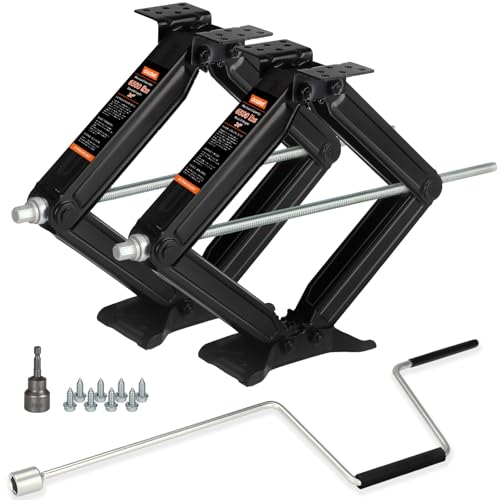
The OULEME set includes two screw-type scissor jacks for leveling and stabilizing campers or trailers. Each jack adjusts from 4 to 24 inches, fitting a range of trailer frames and ground clearances. The pair has a listed 6,500-pound lifting capacity, while the extra-wide base plates help spread pressure on the ground. These are stabilizers, not replacements for a vehicle jack or axle stands.
The kit includes a manual crank, a 3/4-inch drill socket, eight 3/8-inch mounting screws, and an instruction manual. That gives buyers the basic hardware for installation and manual adjustment, with the option to use a compatible drill for faster setup. The jacks measure 26 inches long, 5 inches wide, and 4 inches high when retracted. Their bolts have chromate plating and a salt-spray-tested coating, which should help resist corrosion during outdoor storage and use. Around $69 for two, the set offers useful equipment for a moderate price, though installation still requires suitable tools and a solid mounting location.
Pros
- 4-to-24-inch adjustment range fits many trailer heights.
- Wide base plates provide better ground contact under load.
- Includes a crank, drill socket, eight screws, and instructions.
Cons
- Manual adjustment can take time, especially with repeated leveling.
- The 24-inch maximum height may not suit trailers needing more clearance.
4. LIBRA 9K Scissor Jacks
Best for: RV owners replacing four stabilizers
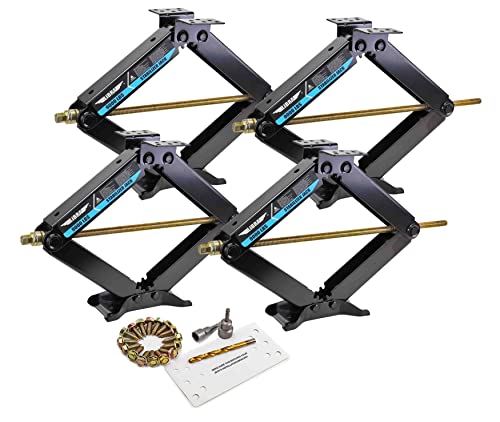
The LIBRA 9K set includes four steel scissor jacks for campers, RVs, and travel trailers. Each jack extends to 24 inches and retracts to 5 inches, with a 26-inch retracted length and 7.5-inch width. The thick 11-gauge steel construction and electrophoresis coating should provide better resistance to wear and corrosion than lighter-duty options. At around $149, this four-pack offers a practical replacement for worn or damaged stabilizers.
The kit includes a 3/4-inch magnetic hex socket for use with a power drill, plus 16 mounting screws, a 9/16-inch socket, a drill bit, and a drilling guide sticker. Those extras reduce the number of separate tools and parts needed for installation. The scissor design adjusts gradually, which helps when leveling a trailer on uneven ground. Still, these jacks are stabilizers only. They should not lift a trailer, support its full weight, or replace proper equipment during tire changes.
Pros
- Four 9,000-pound-rated steel jacks cover a complete RV setup.
- The 24-inch maximum height fits many trailers and campers.
- Included socket and mounting hardware can simplify installation.
Cons
- They cannot safely lift the vehicle or support it during tire work.
- Installation requires drilling into the trailer frame, and the included hardware may not fit every mounting setup.
3. Kohree RV Stabilizer Leveling Scissor Jacks

Best for: Small trailers needing extra stability
This set includes two 24-inch scissor stabilizer jacks for RVs, campers, pop-ups, and trailers. Each jack reaches 24 inches at full extension and retracts to 4 inches, with a 26-inch retracted length and 7.3-inch width. The wide bow-tie base helps spread contact on firm ground. Kohree rates the pair for 7,500 pounds, though these jacks are intended for stabilizing and leveling, not replacing a vehicle’s primary lifting equipment.
Heavy-duty steel construction gives the jacks a solid foundation, while the electrophoresis surface treatment helps protect the metal from wear and corrosion. A hand crank is included, along with a drill bit for faster operation with a compatible power drill. The drill itself is not included. The smooth gear design guides the arms through straight vertical movement, which can make setup more controlled. At around $70, the pair offers useful adjustment range for the price. Check your trailer’s mounting points and ground clearance before buying, since the long retracted length may not fit every frame layout.
Pros
- 24-inch maximum height suits many RV and trailer setups.
- Heavy-duty steel construction supports frequent stabilizing use.
- Includes two jacks, a crank handle, and a drill bit.
Cons
- A compatible power drill is required for faster operation, but it is not included.
- The set has only two jacks, so larger RVs may need a second pair.
2. Kohree Electric Trailer Jack

Best for: RV owners with heavy travel trailers
The Kohree 7500lbs Electric Trailer Jack is a powered tongue jack for RVs, campers, and travel trailers. Its 7,500-pound lifting capacity suits larger setups, while the 22-inch lift range helps accommodate different hitch heights and uneven campsites. Push-button controls handle raising and lowering, and the built-in level gives you a quick reference during setup. The jack sells for around $180, though prices can change.
Several practical details make this model useful at a campsite. A bright LED light helps with hitching before sunrise or after dark. The dual-wire connection supports direct installation, but buyers should plan for basic wiring work rather than a simple plug-in setup. A manual crank provides backup operation if power is unavailable. The weather-resistant cover helps shield the mechanism from rain and dust, while overload protection adds a safety layer during lifting. Kohree includes one year of manufacturer service.
Pros
- 7,500-pound capacity supports heavy RVs and travel trailers.
- The 22-inch range and built-in level simplify hitching and leveling.
- LED lighting and a manual crank improve low-light and emergency use.
Cons
- Direct dual-wire installation may require wiring tools or professional help.
- The roughly $180 price is higher than basic manual tongue jacks.
1. POLESTAR Electric Trailer Jack
Best for: Heavy A-frame trailers and RVs
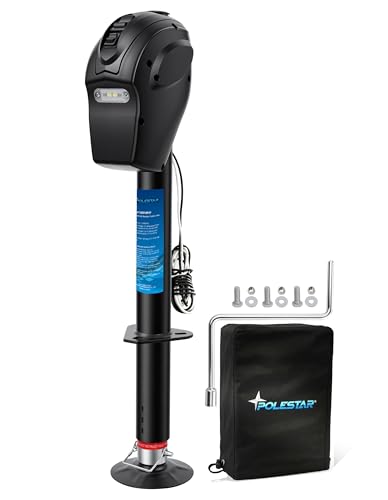
The POLESTAR Electric Trailer Jack is an A-frame tongue jack for trailers, RVs, boats, and off-road equipment. It supports up to 5,000 pounds dynamically and 7,500 pounds for static lifting. Around $181, it costs more than a basic manual jack, but it reduces the effort required to position a trailer.
Its ball screw mechanism works with a brake motor for controlled raising and lowering. The jack extends from 9 inches to 27 inches, while the included 4.5-inch drop leg increases total reach to 31.5 inches. Built-in LEDs illuminate the coupler and hitch area at night. Weather-resistant construction, a waterproof rain cover, and a resettable circuit breaker add useful protection for outdoor storage and regular towing.
Pros
- Strong lifting capacity: Handles up to 5,000 pounds dynamically, with 7,500 pounds of static lifting support.
- Useful height range: Provides 18 inches of powered travel, plus a 4.5-inch drop leg for taller setups.
- Helpful protection and lighting: Includes a rain cover, weather-resistant materials, circuit breaker, and downward-facing LEDs.
Cons
- Higher upfront cost: Around $181 is considerably more than many manual tongue jacks.
- No manual backup is listed: The supplied specifications do not mention a hand-crank override, which could matter if electrical power is unavailable.
Buying Guide
The most important factor is rated lifting capacity. A trailer jack must support the trailer’s tongue weight with a safety margin, or it can bend, jam, or fail under load.
- Load capacity: Choose a jack rated at least 20% above the trailer’s maximum tongue weight. A 1,000-pound tongue load needs a jack rated for 1,200 pounds or more.
- Lift range: Measure the distance from the trailer frame to the ground. Most campers need about 18 to 28 inches of travel, including space for leveling blocks.
- Mounting style: A-frame trailers usually use a top-wind or electric jack with a 2-inch or 2-1/4-inch mounting hole. Match the bracket size and bolt pattern before buying.
- Power source: Manual models cost about $50 to $150 and work without batteries. Electric jacks often cost $150 to $400, but they need a 12-volt connection and an emergency hand crank.
- Base and weather protection: A footplate at least 6 inches wide helps prevent sinking on soil. For frequent outdoor use, choose a zinc-plated or powder-coated steel body with a sealed switch.
If you must compromise, prioritize capacity first, then confirm the jack fits your trailer’s mounting point.
Frequently Asked Questions
How do I choose a jack for a camper trailer?
Choose a trailer jack by matching its rated capacity, lift range, mounting style, and trailer weight. A jack rated for at least 2,000 pounds may suit many small campers, but check the loaded tongue weight and manufacturer limit, not the trailer’s total weight.
What size jack do I need for my camper?
Most camper trailers need a jack rated above their loaded tongue weight, with extra capacity for uneven ground and movement. For example, a 2,000-pound jack may work for a 600-pound tongue load, while heavier dual-axle trailers can need 5,000 pounds or more. Check the coupler height and required lift before selecting.
Can I use a regular car jack on a travel trailer?
You can use a car jack only if its capacity, lift height, and contact point match the trailer and the manufacturer allows it. Many bottle and floor jacks are not designed for trailer tongue loads or frame shapes. A 2-ton rating does not guarantee safe support, and you should never use it as the sole support while working underneath.
Are electric tongue jacks better than manual ones for camper trailers?
Electric tongue jacks are more convenient, while manual models are usually lighter, cheaper, and less vulnerable to battery problems. A powered unit may lift with a switch, but a manual jack still works when the battery is dead. Choose based on camping habits, tongue weight, and available storage.
Conclusion
POLESTAR Electric Trailer Jack is the top recommendation for campers who want powered lifting, easier hitching, and less cranking at the trailer tongue, especially owners who move their camper often or have limited hand strength. If your priority is a lower purchase price, simpler maintenance, or dependable use without a battery connection, choose a manual tongue jack instead, accepting that setup takes more effort and time. Before buying, double-check the jack’s lift range, weight capacity, mounting dimensions, and fit with your trailer frame, then confirm how many jacks your setup requires and compare the current price across reliable sellers. A careful match prevents clearance problems, overloads, and an expensive return after delivery.

